


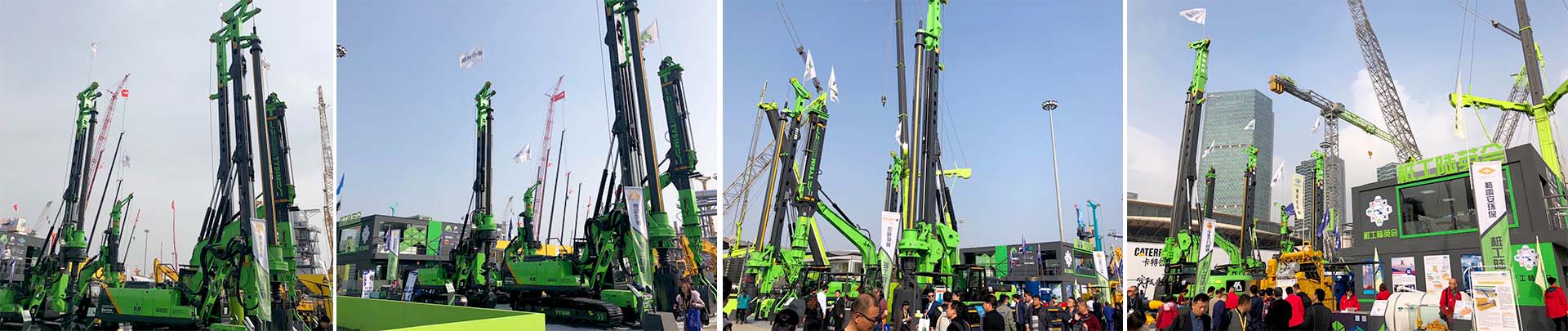
On September 14, 2026, the first foundation pilot and groundbreaking ceremony for a key section of the ±800 kV ultra-high-voltage direct current transmission project from Southeast Tibet to the Guangdong-Hong Kong-Macao Greater Bay Area was successfully held in Wenshan, Yunnan.
At the project site, the TYSIM KR200D heavy-duty integral-transport power construction drilling rig, jointly developed by TYSIM and the State Grid Hunan Electric Power Research Institute, was put into operation. During the event, TYSIM also completed a live demonstration of its 5G remote intelligent control system, highlighting the application of intelligent drilling technology in large-scale power infrastructure construction.
The project represents an important application of mechanized and intelligent construction equipment in ultra-high-voltage transmission tower foundation engineering, particularly in mountainous areas with complex terrain and demanding construction conditions.


KR200D Supports UHV Transmission Foundation Construction in Mountainous Terrain
The Southeast Tibet–Greater Bay Area UHV DC transmission project is a key energy infrastructure project under China’s 14th Five-Year Plan.
Much of the transmission route passes through mountainous areas, where construction sites are characterized by complex terrain, difficult access and challenging operating conditions. These factors place high requirements on the mobility, heavy-load capability, stability and intelligent operation of foundation construction equipment.
Transmission tower foundation construction in mountainous areas often requires drilling equipment to move efficiently between dispersed work sites while maintaining sufficient drilling performance for large-diameter and deep foundation holes.
To address these challenges, TYSIM and the State Grid Hunan Electric Power Research Institute have worked together for seven years on the development and optimization of specialized power construction drilling rigs.
The collaboration has focused on actual power grid construction conditions, with continuous improvements in equipment structure, drilling capability, site adaptability and intelligent operation.
According to the project materials, TYSIM power construction drilling rigs have already been deployed in more than 28 provinces across China and have participated in over 1,000 power grid infrastructure projects.


KR200D Designed for Efficient Power Grid Foundation Drilling
The KR200D power construction drilling rig showcased at the project is one of the key results of the seven-year industry-research collaboration.
A major feature of the KR200D is its integral-transport design. Unlike equipment that requires repeated disassembly and reassembly during relocation, the KR200D can be transported as an integrated unit, helping simplify equipment transfer between construction sites.
This is particularly valuable for power transmission projects in mountainous areas, where construction points may be widely distributed and site access can be difficult.
The KR200D is also equipped with a reinforced heavy-duty chassis and a high-performance power system, enabling the machine to adapt to rugged mountainous road conditions and demanding foundation construction environments.
For ultra-high-voltage transmission tower foundation construction, the machine is designed to support large-diameter and deep foundation drilling, while its high-torque rock drilling capability helps improve drilling efficiency in hard geological formations.
The equipment also incorporates a 360-degree panoramic imaging system, providing operators with improved visibility around the machine and helping reduce operational risks in complex field environments.
These features make the KR200D particularly suitable for power grid foundation projects where equipment mobility, drilling efficiency, stability and safety are all important.
5G Remote Control Enables Cross-Regional Drilling Operation
One of the highlights of the event was the live demonstration of TYSIM’s upgraded 5G remote intelligent control platform for power construction equipment.
During the demonstration, operators worked from a remote control cabin at TYSIM’s headquarters in Wuxi, Jiangsu, while remotely controlling the KR200D operating at the construction site in Yunnan.
The two locations were more than 3,000 kilometers apart.
With the support of 5G high-speed communication technology, operators were able to remotely control the drilling rig while the equipment maintained stable response, precise operation and reliable performance at the construction site.
The demonstration showed how remote intelligent control technology can be integrated into power grid foundation construction, providing a new approach to equipment operation in remote, mountainous or higher-risk working environments.
Improving Safety Through Remote Intelligent Operation
Remote operation offers several potential advantages for power construction projects.
In traditional transmission foundation construction, operators and construction personnel often need to remain close to heavy equipment in difficult site conditions.
With remote intelligent control technology, selected equipment operations can be performed from a remote control environment, helping separate personnel from higher-risk operating zones.
This human-machine separation can be particularly valuable in mountainous construction areas where terrain, weather conditions and access limitations may increase operational difficulty.
According to the project materials, the remote control platform is also designed to support the coordinated management of multiple rotary drilling rigs from a single control console.
For large power grid projects involving multiple transmission tower foundation sites, this type of centralized equipment management can help improve equipment coordination, optimize manpower allocation and enhance overall construction efficiency.
Seven Years of Industry-Research Collaboration
Post time: Sep-24-2026